4. Paradigm predictability
Predictability measures
Implicative entropy (Bonami & Beniamine 2016) and probability of succes (Bouton & Bonami 2026) measure the predictability of morphological paradigms. Given a form from a predictor cell, how difficult is it to produce the corresponding form in the target cell?
Qumin is able to perform efficient predictability computations on large paradigms. For more details, refer to the relevant publications.
The command is the following:
qumin action=pred data=parakar/parakar.package.json \
patterns=results/patterns/metadata.json \
cells="[abl.sg, gen.sg, part.sg]" hydra.run.dir=results/entropies pred.export_log=True
There are two things to notice:
We passed the path to the result of the patterns computation with
patterns=<path to metadata.json>. If you don’t provide pre-computed patterns, Qumin will compute them first.We asked Qumin to export the details of entropy calculations
pred.export_log=True. This is much slower and generated very long logs. It should only be done when using a small sample of paradigm cells or lexemes, but not on a real size dataset.
Tip
You can also set hydra.verbose to different verbosity levels (see the hydra doc).
Tip
Learn how to speed up these computations in this How-to.
Output
The script outputs the average paradigm entropy in the terminal. Here:
|                      |   H(c1 -> c2) |
|:---------------------|--------------:|
| Mean                 |      0.242707 |
| Weighted with tokens |      0.276709 |
This is a mean across all cells. Detailed results are provided in the result files, as a frictionless package, with the following content:
cli.log: the log from the computationmetadata.json: the metadata descriptorentropies.csv: computation results/vis: a folder containing various visualisation of the results (see the next section).
You can open entropies.csv with any tabular data editor:
predictor |
predicted |
measure |
value |
n_pairs |
n_preds |
dataset |
pair_proba |
pred_proba |
target_proba |
proba_source |
abl.sg |
part.sg |
cond_entropy_debug |
0.4539732651 |
4975 |
1 |
parakar |
0.08886016233937774 |
0.1838868388683887 |
0.3943726937269373 |
tokens |
abl.sg |
gen.sg |
cond_entropy_debug |
0.0 |
4975 |
1 |
parakar |
0.09502667652901096 |
0.1838868388683887 |
0.421740467404674 |
tokens |
abl.sg |
part.sg |
cond_entropy |
0.4539732651 |
4975 |
1 |
parakar |
0.08886016233937774 |
0.1838868388683887 |
0.3943726937269373 |
tokens |
abl.sg |
gen.sg |
cond_entropy |
0.0 |
4975 |
1 |
parakar |
0.09502667652901096 |
0.1838868388683887 |
0.421740467404674 |
tokens |
Each row corresponds to a record. Crucial metrics are in the value column. The last four columns inform you about the relative frequency of this pair of cell in the lexicon (if token frequencies are available).
The pred/human_readable/1pred/distrib_log_1pred_*.md files contain details on the computation for each pair of cells. For instance for the part.sg→gen.sg prediction:
# Distribution of part.sg→gen.sg

Showing distributions for 194 classes

## Class n°0 (1070 members), H=0.0

|    | Pattern              | Example               |   Size |   P(Pattern|class) |
|---:|:---------------------|:----------------------|-------:|-------------------:|
|  0 | u͜ɑ ⇌ ɑn / X+[-syll]_ | abai: ɑbɑju͜ɑ → ɑbɑjɑn |   1070 |                  1 |

## Class n°1 (453 members), H=0.973227545543577

|    | Pattern                        | Example                      |   Size |   P(Pattern|class) |
|---:|:-------------------------------|:-----------------------------|-------:|-------------------:|
|  0 | _tu ⇌ k_en / X*[-long -dip]_s_ | abevus: ɑbeʋustu → ɑbeʋuksen |    270 |           0.596026 |
|  1 | stu ⇌ zen / X*[-syll][-tri]_   | agjaine: ɑgjɑstu → ɑgjɑzen   |    183 |           0.403974 |
This shows a breakdown for each category of lexemes. 1070 lexemes end in ua in the partitive: they always end in an in the genitive and there is no uncertainty: the entropy is 0, etc. By reading the full log, you can get a very detailed picture of what is going on.
Tip
Have a look at the predictability CLI reference to see all available options for entropy computations:
Computing from multiple predictors
Adding known features to improve prediction
Visualizations
Qumin can create a few useful visualisations that can help you understand your data at a glance. You can find them in the vis folder.
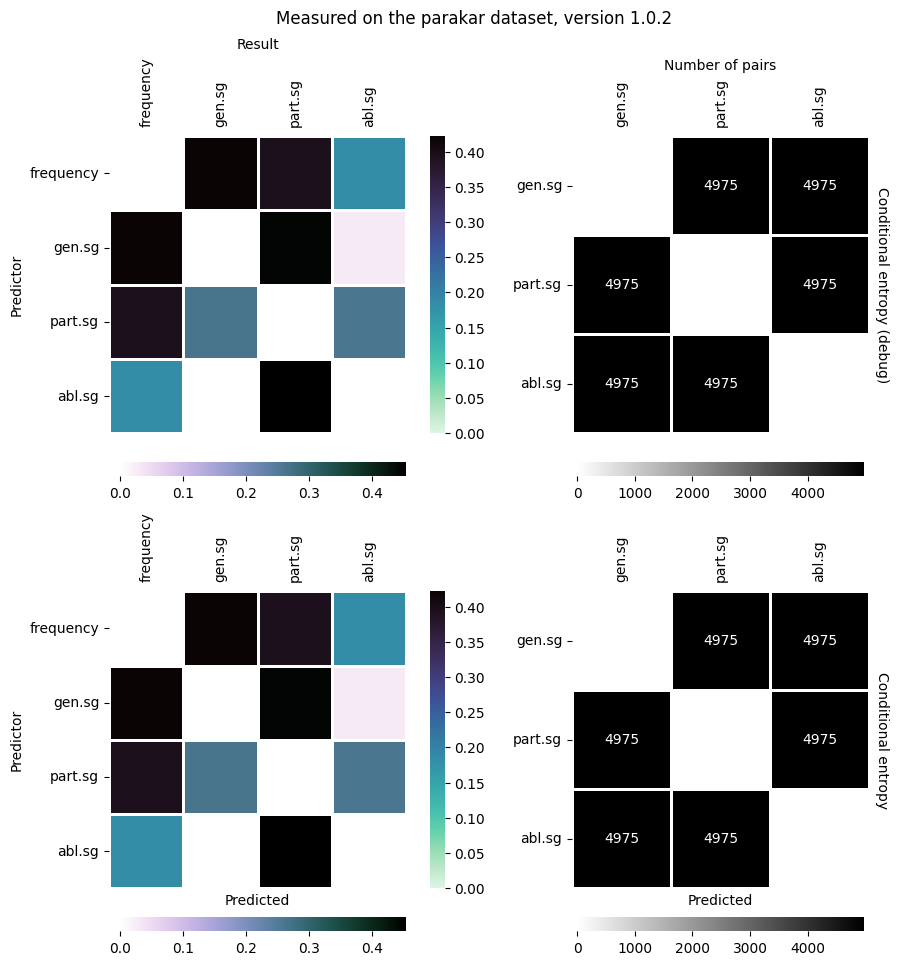
The most important is the heatmap: a matrix that shows how well each cell predicts each other cell. The higher the value, the darker the colour and vice-versa:
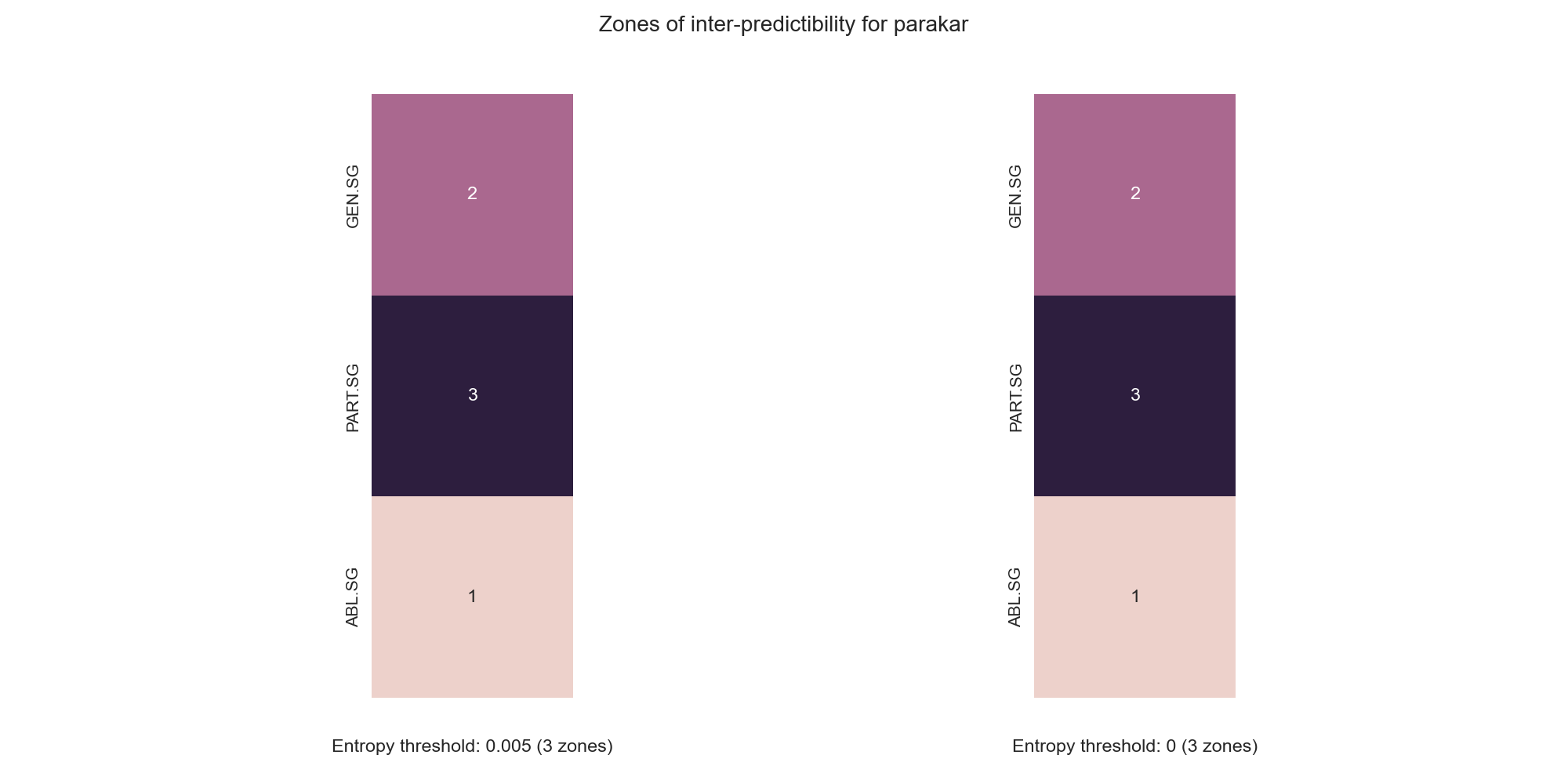
Qumin also tries to identify zones of interpredictability, that is sets of cells that are completely interpredictable. Our dataset, does not contain such cells:
To fine-tune these plots, you can rerun the algorithm on pre-computed entropies with the following command:
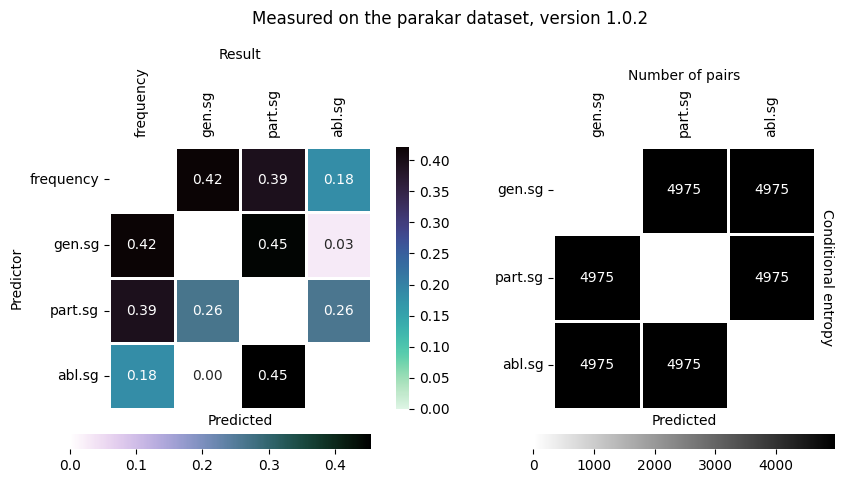
.. Here, the heatmap.annotate keyword asks to add the numeric results to the heatmap:
qumin action=pred_heatmap data=parakar/parakar.package.json \
pred.importResults=results/entropies/metadata.json \
hydra.run.dir=results/heatmaps heatmap.annotate=True
And the result:
Tip
Have a look at the heatmap CLI reference to see all available options for entropy visualizations.